The Road to Juneteenth and the Stories We Choose to Tell
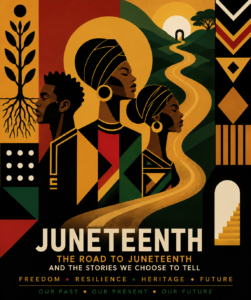
I grew up in the Deep South, way out in the country, just South of Birmingham, Alabama, during the Civil Rights Movement. I saw the news. I heard the stories. The thing is, from where I was sitting, a child of the 60s, I didn’t think those stories went far enough, if they even got told at all. Even then, I saw them as sanitized, missing in the raw brutality of the racial hatred that I saw around me.
With time, the stories were told, at least some of them. I was late watching the movie, The Help, but when I did, it resonated like few other. I am aware of the backlash it got as a “White savior” narrative, telling the story of the Black hired help from the perspective of a young White female writer. However, I also understand why it resonated so deeply with audiences of the time.
The movie served as a bridge for many viewers, myself included. It introduced difficult conversations through a perspective that felt familiar before leading us toward perspectives that many of us had not previously understood. While Octavia Spencer will be forever remembered for her triumphant pie in the role of Minny Jackson, the maid, it was the protagonist Skeeter Phelan, who captured my attention. Like her, I was also a young aspiring White Southern female writer. I too had an African American nanny, Frankie Mae, who cared for me. The nurturing she provided was instrumental in my early years and how I would look at the changes that were unfolding in the world around me.
The Civil Rights Movement was a fight that had to be, but deep in my soul, I felt like the stories were sanitized into some kind of Hollywood perfect rating. As a White Southern female coming of age during this time, I was well aware that when it came to issues of Black and White, the hardest truths were not generally making it to print.
As the Civil Rights Movement progressed, I thought often of Frankie Mae. I rebelled at the thought of the so called “Christian Schools” that were built for no other reason than to exclude people like her, the one who nurtured me when I was the youngest and at my most vulnerable. I was always the quiet one, but the loudest, most vocal rebellion of my teen years was when I refused to go to a Christian School. I didn’t see a thing Christian about those schools, and I let that be known.
With time, the news started providing more balanced coverage of race related stories. Social media brought attention to many things that were not previously covered. Museums and parks started to provide more balanced displays in the telling of our history. There were efforts throughout the nation to get these stories told.
* * *
Fast forward to Lucille Clifton, one of my all-time favorite poets: She included African American experiences in her poetry. She could spin you like a top with her poetry. Pun intended. Reading her most hilarious poem, “Homage to My Hips,” which was about her very ample hips, she’d have the whole audience rolling in their seats as she sashayed across the stage, playfully leaning into their expectations of a warm, larger-than-life Black woman. Then, when you didn’t think you could laugh any harder, she’d punch you in the gut with her absolutely brutal poetry about slave ships. That’s when she got real.
I had the privilege of meeting Clifton several times when she came to read at Alabama A&M, a local HBCU, and later through mutual poet friends. Living a life true to her convictions, she refused to visit Birmingham because of what went on there during the Civil Rights Movement.
Lucille Clifton believed strongly that Southern plantations should also tell the stories of the enslaved people who made those places possible, not simply preserve a romantic image of the Old South. On her own personal mission, she visited as many of those old plantations as she could. At every stop, she talked to them about telling both sides of the story of slavery in the South, to let go of the tarnished plantation glamour and include the stories of the enslaved people who worked to make it happen. Her efforts were successful.
Clifton didn’t do it alone. It was through the efforts of many writers, poets, organizations and private individuals, and even movies, that we started to get a more nuanced picture of our history. Today, it concerns me that we are beginning to sanitize those stories once more, to make them comfortable again, to hide ugly truths that sometimes took generations to be brought to light. Our US President Donald Trump has been sanitizing displays in our National Parks and Museums, all while declaring that he doesn’t want the US presented in an ugly, uncomfortable light. In history, there is good, and there is bad. We need both. With that, I put my teacher hat back on for a minute.
* * *
Although it didn’t begin there, following nationwide racial justice protests in 2020, many museums, historical sites, and national parks updated their signage, tours, and brochures to include more diverse perspectives, specifically highlighting the experiences of Indigenous peoples, enslaved laborers, and marginalized groups.
These efforts were not without backlash, just a few short years after the success of those and other efforts, Trump directed the National Park Service (NPS) and the Department of the Interior to remove displays, signs, and interpretive materials that he felt portrayed the country as “inherently racist, sexist, oppressive or otherwise irredeemably flawed” or that “inappropriately disparage Americans past or living.” The stated goal was to change how aspects of American history are presented.
The result is that some of the most difficult chapters of our history are once again in danger of becoming less visible. At least 51 exhibits across 37 different national parks and hundreds of additional interpretive materials have been altered, removed, or flagged for removal.
One of the most high-profile removals occurred at Independence National Historical Park. They removed large outdoor panels detailing the lives of the nine enslaved people held by George Washington at the property in Philadelphia, Pennsylvania.
Approximately 80 items, including interpretive markers along the Selma to Montgomery National Historic Trail, which commemorates the 1965 Voting Rights March, were marked for review or removal.
The removals have sparked immense pushback from historical associations, park rangers, and conservation groups, leading to ongoing legal challenges. It’s not over yet though. There are a whole lot of people out there who feel like the truth is kind of important.
* * *
So now, in the midst of the removal of numerous important historical exhibits, we celebrate Juneteenth. I didn’t know a thing about Juneteenth until well into adulthood. Having grown up in the heart of the Civil Rights Movement, you’d think I knew, but I didn’t.
Juneteenth marks the moment that the very last major group of enslaved Americans finally learned that they were free. It took two and a half years for the news, along with the military power required to enforce it, to reach the most remote corner of the Confederacy, which was Galveston, Texas.
* * *
Why did it take so long?
On January 1, 1863, President Abraham Lincoln signed The Emancipation Proclamation declaring that all enslaved people in Confederate states “are, and henceforward shall be free.” The problem was that, in 1863, the Union didn’t actually control Texas. Since it was off to the side, and geographically isolated from the rest of the South, it saw very little fighting during the Civil War, and thus became a safe haven for slaveholders. Owners from others states moved there with enslaved people to escape the advancing Union Army. On June 19, 1865, which came to be known as Juneteenth, two months after Confederate General Robert E. Lee surrendered at Appomattox, Union Major General Gordon Granger finally arrived in Galveston with 2,000 federal troops to occupy the state and enforce the law.
Although many Texas slaveholders knew about the Emancipation Proclamation, they hid the news from their enslaved workers. Not only did they not know, until General Granger arrived, there were not enough federal troops in Texas to overcome the local plantation owners.
When General Granger stepped onto Texas soil, he read General Order No. 3 aloud from the headquarters of the District of Texas. The news was now known. The order stated:
“The people of Texas are informed that, in accordance with a proclamation from the Executive of the United States, all slaves are free. This involves an absolute equality of personal rights and rights of property between former masters and slaves…”
For the estimated 250,000 enslaved people in Texas, this news triggered immediate celebrations, prayers, and a massive migration as people left plantations to find lost family members that had been separated by slavery.
While Juneteenth celebrates the end of slavery in the Confederacy, it didn’t end slavery for the entire country. The Emancipation Proclamation only applied to states that had seceded. Enslaved people in “loyal” border states (such as Kentucky and Delaware) were not legally freed until the 13th Amendment was officially ratified six months later, on December 18, 1865.
That’s it. History matters. Forgetting has consequences. Information is kind of important. That’s why we celebrate Juneteenth, why we remember Frankie Mae, and the poetry of Lucille Clifton, why we cheer every time we see a clip of Minny Jackson and her pie, why the road from Selma to Montgomery is a sacred pilgrimage, why General Granger standing up and reading that proclamation out loud was so important, why the day became known as Juneteenth, and why every single one of those museum and park exhibits that remind us of what really came before us are so important. All of those people and all of those things remind us of that, of who we are and where we came from. Yes, history matters. Forgetting will have consequences. Whichever way we choose to do it, keeping the information out there is kind of important.
* * *
Further Viewing
Lucille Clifton’s reading of “Homage to My Hips” gives readers a chance to hear the confidence, humor, and authority in her own voice. Her life’s work became an important part of the literary bridge that expanded whose stories were heard and celebrated.
Stories take many forms. Sometimes they arrive as poetry. Sometimes they arrive as history. Sometimes they arrive wrapped in humor sharp enough to expose the ugliest of truths. Minny Jackson’s famous pie scene remains one of those unforgettable moments.
Sources
*The discussion and definition of a “bridge story” grew out of a conversation with ChatGPT during the development of this essay.
*Background historical research was assisted by Google Gemini for specifics on Juneteenth and the recent removal of artifacts from National Parks and Museums.