Labor Day and the Folks Where I Come From: “A Reprise”
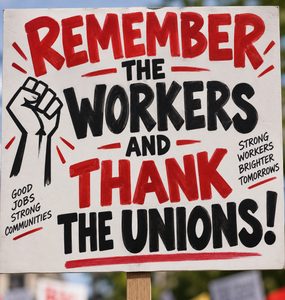
“Remember the workers, and thank the unions.” Labor Day is about the working folks and their rights in this country.
When I first wrote about Labor Day, I thought I was writing about the holiday. I always loved a good holiday, but looking back, I am not so sure now. It didn’t seem quite so important as some of the other holidays. In fact, I never thought that much about it at all; maybe do a household chore and call the day a win, and then eat some barbecue to make it a celebration. But Labor Day is about the working folks and their rights in this country. That doesn’t sound much like a party to me, and it could be that it wasn’t. It could also be that Pea Ridge, where I grew up, was more important to that holiday than I will ever know.
Workers’ rights, the kind that Labor Day is really about, were important where I grew up, and sometimes a matter of life and death. Growing up on Pea Ridge, with my grandparents right next door, I picked up tidbits, bits and pieces, stories from my granddaddy, William Joseph “Pa Bill” Pickett, and his wife, Azalea “Nanny” Pickett, my grandmother too, but kids do not really have the understanding to comprehend a whole lot of such until they are a whole lot older. If they ever are.
Nanny used to tell me about what it was like being so very poor with a house full of kids to feed. She told me that whatever anybody brought home, that was what they had for dinner. If somebody went fishing and caught a few fish, they had fish. If they went hunting and shot a squirrel, she fried it up and made gravy and mashed potatoes. We still thought fried squirrel and gravy was a delicacy when I was a kid. They also foraged and picked berries. I have sure picked my share. Everybody kept gardens too; that was a given. A few chickens, and whatever else you could raise. All of that was an everyday part of life on The Ridge.
Pa Bill was a coal miner, and being as they lived next door, I used to hang out with him a lot: walking through those woods, over those hills, and across The Ridge. He talked about work in the coal mines. Those were some hard times, and after years of working to the bone, poor as dirt the whole time, trying to feed his family, and never quite having enough, he was disabled with “black lung.”
Black lung was what they called “coal workers’ pneumoconiosis.” It was a disabling and sometimes fatal lung disease caused by years of breathing coal-mine dust. With five kids still in the house when he was disabled, his oldest, my “Uncle Carl,” dropped out of school and went to work to help feed the family and get the others through school. It wasn’t just him; a whole lot of folks in those parts were going to work real young back then. It was a matter of survival.
Pa Bill was not a large man. As long as I could remember, he was kind of frail, dealing with the black lung and walking with a stick. The stories he told me about his life working in the coal mines were what got me started writing in the first place. Before it was done, those stories had me thinking pretty hard about politics too.
There was one incident that Pa Bill told me about that troubled him for the rest of his life. It stayed with me for the rest of mine too. There was convict labor in the mines back then, and they had a cemetery for the convicts. You think things were bad for the workers. Pa Bill was one of the free coal miners, working there of his own choice. If you can even call it that. One of the bosses came to him one day and told him to dig a grave. Nobody was dead.
Pa Bill was poor, had a third-grade education, and a family to feed. He dug the grave.
That grave haunted him for the rest of his life. It haunted me too. That story was why I decided to be a writer.
The use of convict labor is well-documented in the mines in that area, and there is still an old convict cemetery in the area. It can sometimes be toured through arrangements with the Aldrich Coal Mine Museum Inc., which is a few miles down from The Ridge.
This is not to say that the miners didn’t try to stand up for right, and their own rights too. Pa Bill was a very active member of the United Mine Workers of America (UMWA), and so were a lot of his family and friends in the Pea Ridge, Shelby County, Alabama, area. To this day, the efforts of those early union members remain important to the rights of workers. Sam Littlefield was one of those friends, and he is important to this story. He was also President of UMWA District 20.
I was driving along one day when it came on the radio that Sam Littlefield had been shot. He had been shot dead in a hotel in Washington, DC.
That was back in November 1974. I stared down at the radio. This was not some stranger on the news; this was one of Pa Bill’s old friends. Came from the same hills we did. Sam hung around with Pa Bill now and again. They hunted, went fishing, and talked union. I knew Sam Littlefield long before I had a clue who Sam Littlefield was.
Sam was shot and killed in what authorities said was a random armed robbery that he happened to walk in on in a hotel room in Washington, DC. There is no doubt that it could happen, but nobody in those parts ever believed that was all there was to that story.
Sam was in DC for some national coal-contract negotiations. It was a contentious time in the coal industry. Back home, the miners in District 20 were also fighting the proposed import of South African coal. I am not going to go into all the history of those meetings, but there were some serious conflicts between the coal miners and the coal-industry interests of the day.
The official account was that Sam Littlefield was shot when he walked up on a robbery in progress. A man was arrested, tried, and convicted of his murder. His conviction was later upheld by the District of Columbia Court of Appeals in the Reavis v. United States case. That settled the case for the courts, but I am not sure it settled it for much of anybody on Pea Ridge. Most of the folks who used to talk about it are gone now, and Sam Littlefield was laid to rest in the Macedonia Church Cemetery, the same cemetery where our families have been buried since they moved to the area back in 1814.
Knowing the things that Pa Bill told me, where I came from, and what our people went through, I have a real hard time when folks do not understand that unions and the rights of working folks are important. Sam Littlefield devoted much of his life to working to make things better for the coal miners, only to be shot dead while he was in DC for union negotiations. Other miners flat out died or worked until they were completely disabled and could not work another day in those mines or anywhere else. Blood was shed, and lives were lost when folks started trying to improve the conditions for the workers in this country. They were working to the bone and still starving.
It was not just on Pea Ridge, though; it was all over the country. It still is for some. But those old union members did a lot of good toward improving the rights and well-being of the workers in this country, and some of the ones from Pea Ridge were right there leading the fight. The UMWA was very involved in the fight both to control coal-dust exposure, so fewer miners would be disabled by it, and to have black lung recognized as a “compensable occupational disease.” The federal program, which they worked so hard for, began under the 1969 Coal Mine Health and Safety Act. It was expanded again in 1972. I still remember the joy of so many of the coal miners, who had worked so hard and been so poor for so long, when they were given compensation for the disabilities they had suffered with black lung. It didn’t make them rich, but they were finally able to do some of the little things that folks tend to take for granted when they see to the needs of their family and home.
Although the unions didn’t do it all on their own, they contributed tremendously to the effort to improve conditions for the workers in this country. Some of the hard-won protections, benefits, and working conditions that a whole lot of folks take for granted today include the eight-hour workday and the 40-hour workweek, a day or two off every week, overtime pay, a minimum wage, restrictions on child labor, workplace safety standards, paid vacations, holidays, sick leave, health insurance, retirement plans, and the list goes on.
Unions are not always well-regarded these days. It could be that the powers that be never really liked them too much, but they have done a lot to improve the rights and well-being of the workers in this country. Give them a thought and a little bit of thanks as you fire up the grill this Labor Day weekend. Don’t ever forget where you came from, and the sacrifices of the good, hard-working folks who came before you.
Also note:
— Although this is my own original writing, I used ChatGPT for fact-checking, dates, and to correct my grammar. I also used it to create the image.
— The original idea for this article, Labor Day and the Folks Where I Come From, was a post I did on my Now Y’all Blog in September 2018.
— The History of Labor Day — also on Across the Ridge.
— The Aldrich Coal Mine Museum on Facebook.